In authoritarian contexts, policy-making can come in many different forms. In personalist governments especially decisions can just be made with no consideration of formal institutions. However, as we have explored in the class and readings, it is possible to find authoritarian governments that at least try to portray a front of democracy, Rwanda is one of these cases.
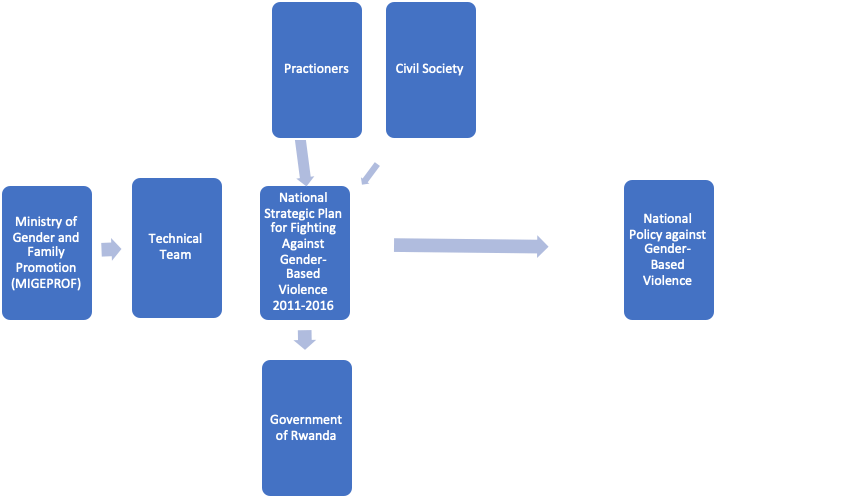
Rwanda is indubitably an authoritarian state, under the control of a single leader for the past two decades and likely to remain under his influence and that of his party for at least a decade more. As I discussed in previous blog posts, Rwanda in many ways could be considered a personalist regime, though perhaps not to the same extent as other examples, at the very least it is very clearly under single-party rule. However, it does have the trappings of democracy. That includes formal institutions through which laws must pass and the National Policy against Gender-Based Violence, illustrated above, is a prime example.
Rwanda in general has many policies relating to gender equality. The National Policy against Gender-Based Violence itself was created in 2011, part of a number of other programs, including the National Gender Policy and ongoing work to adhere to International law including the Convention on the Elimination of All Forms of Discrimination against Women and United Nations Security Counsel Resolution 1325.

Members of the Rwandan Police supporting the Orange the World Movement started by UN Women. Orange the World was a campaign against Gender-Based Violence lead by UN Women and other partners. Gender Equality campaigns are common in Rwanda and the Government has shown itself to be an ardent supporter of women’s rights.
The policy was launched by the Ministry of Gender and Family Promotion (MIGEPROF) of the Republic of Rwanda, a government institution which is charged with a number of mandates including promotion of gender equality. As can be seen in the flowchart above, the National Policy against Gender-Based Violence came from a technical team, launched by MIGEPROF. The formation of the Strategic Plan to Fight GBV was created with consultation from the Rwandan Government, Civil Society and Practitioners all of which produced the Policy.
Not only were numerous formal institutions involved in the creation of the policy, but civil society as well as other parts of the government were consulted. This shows a clear multilateral effort with multiple stakeholders, a necessity in democracy at least for this policy.
However, this is just one example and does not mean that formal institutions are always used in the country. With Gender Equality, Rwanda, and Paul Kagame especially, has portrayed itself as a major player in the international field. Often Kagame attends international events and collaborates with international partners on this particular issue. Though of course it is an admirable goal, it could maybe be said that Rwanda’s openness and transparency on these certain policies, those that they often work on with international organisations, could be a way to brush aside possible accusations of authoritarianism and oppression in the state. By showing clearly what they are working on in this one arena, they can pull focus away from arenas which might not garner as much international support. This in fact is an increasing criticism of world leaders’ interactions with Kagame, as many praise his good works but ignore the oppression in his nation.
Source: Republic of Rwanda Ministry of Gender and Family Promotion, “National Strategic Plan for Fighting Against Gender-Based Violence 2011-2016)” (2011). https://migeprof.gov.rw/fileadmin/_migrated/content_uploads/GBV_Policy_Strategic_Plan-2.pdf
Other Works Cited:
Kagame, P. (2013, July 5). Gender equality is a right, not a favor. Paul Kagame. http://paulkagame.com/?p=2594 Mpoke-Bigg, A. (2019, November 25). Global Gender Summit 2019: African leaders take on the responsibility to urgently close the gender gap [Text]. African Development Bank. https://www.afdb.org/en/news-and-events/press-releases/global-gender-summit-2019-african-leaders-take-responsibility-urgently-close-gender-gap-32858 Orange the world in 16 days. (2016, November 25). UN Women. https://www.unwomen.org/en/news/stories/2016/11/orange-the-world-2016 Sundaram, A. (2014). Rwanda: The darling tyrant. POLITICO Magazine. https://www.politico.com/magazine/story/2014/02/rwanda-paul-kagame-americas-darling-tyrant-103963.html UNECA. (2014). Republic of Rwanda: Report on the Implementation of the Beijing Declaration and Platform for Action (1995) and the Outcomes of the Twenty-Third Special Session of the General Assembly [Country Report]. https://www.uneca.org/sites/default/files/uploaded-documents/Beijing20/NationalReviews/natl_review_rwanda_-_eng.pdf
 Rwanda Reconsidered